Library description
1. Installation
To install jajapy just run the following command:
>>> pip install jajapy
2. Workflow
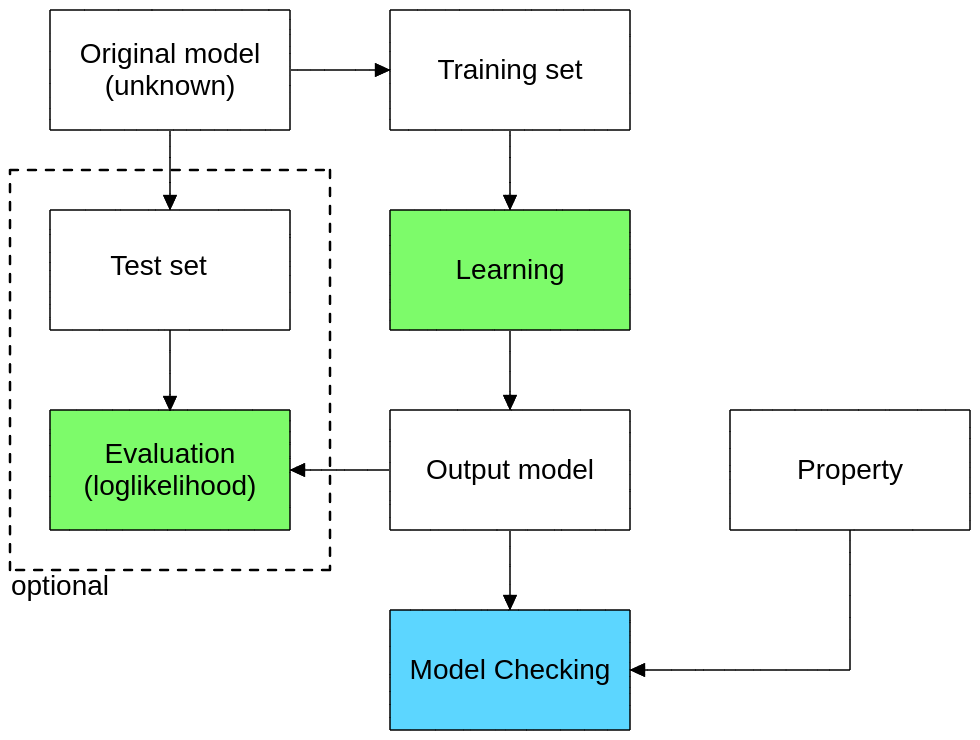
A complete workflow. In green: algorithms provided by Jajapy. In blue: algorithms provided by Stormpy.
Model checkers, such as Storm or Prism, offer different methods to analyse stochastic models. However, the model under analysis must be provided, while, in many cases, system behaviours are accessible instead of the model itself.
Jajapy is a python extension to the Storm model checker, which learns stochastic models from system behaviours. Given a dataset, Jajapy automatically generates a Markov model in Stormpy format. Additionally, Jajapy model can be save to a Prism file.
Jajapy output models are directly translated to a Stormpy sparse model by default (if Stormpy is installed on the machine).
You can change this behaviour by changing the value of the parameter stormpy_output of the fit function.
Jajapy basic usage can be described in few steps:
Getting the training set,
choosing the learning algorithm,
executing it (this may take some times),
your model is ready, you can use Stormpy to model check it!
Note
HMMs and GoHMMs (see below) are not compatible with Storm and Prism: Jajapy can only learn them.
3. Models
Jajapy supports different kind of Markov models that have different properties.
The following table summarizes the main properties of these models. The second column indicates if, at each timestep, a model generates a discrete observation, or a vector of continuous observations (this vector can possibly contains only one value). The third column indicates if the model is deterministic or not. The fourth one shows if the model is a continuous time model (or a discrete time model). A continuous time model will wait in each state for some period of time (called dwell time) before moving to another state. Finally the last solumn indicates if the model is parametric. In a parametric model, transition probabilities can be expressed are polynomial composition of parameters. A parameter can be involved in several transitions.
Model |
Observations type |
Deterministic |
Continuous time |
Parametric |
|---|---|---|---|---|
HMM |
Discrete |
Yes |
No |
No |
MC |
Discrete |
Yes |
No |
No |
MDP |
Discrete |
No |
No |
No |
CTMC |
Discrete |
Yes |
Yes |
No |
PCTMC |
Discrete |
Yes |
No |
Yes |
GoHMM |
Vector of Continuous |
Yes |
No |
No |
One can wander what is the difference between MC and HMM: each MC state is labelled with exactly one observation, which is seen each time we are in this state. On the other hand, each HMM state is associated with a probability distribution over the observations. Each time we are in this HMM state, an observation is generated according to the probability distribution associated to this state.
4. Jajapy and Stormpy
Note
This section concerns MDPs, MCs, CTMCs and PCTMCs only. Other models are not compatible with Stormpy.
Jajapy uses its representation of the models during the learning process. Once the learning process is over, Jajapy converts the output model to a sparse Stormpy model.
The initial hypothesis of the Baum-Welch algorithm can be:
a random model: then the number of state and alphabet only should be provided to Jajapy,
a Jajapy model,
a Stormpy sparse model.
These translations are straightforward and doesn’t change the structure of the models.
Note
Stormpy models can be translated to Jajapy ones only if all states in the Stormpy model are labelled with at most one observation.
Initial distributions and the init label
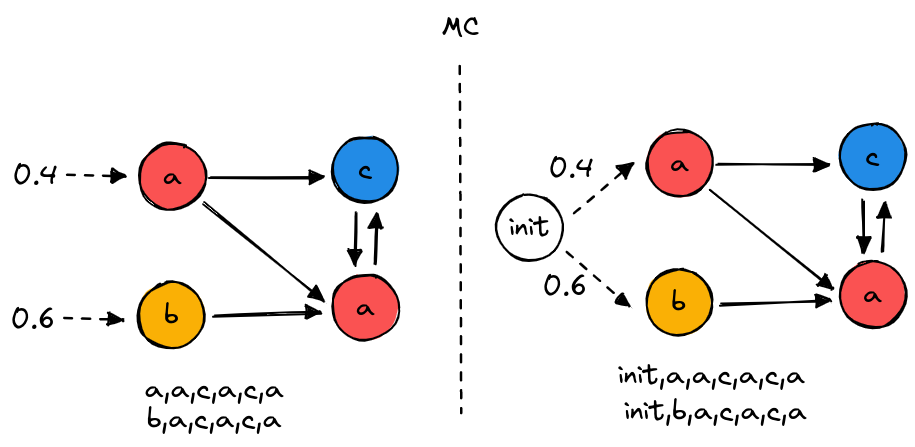
Stormpy doesn’t handle initial distribution: it chooses the intial state according to an uniform distribution over the states labelled with init. On the other hand, Jajapy chooses the initial state according to any discrete distribution over the states defined by the user.
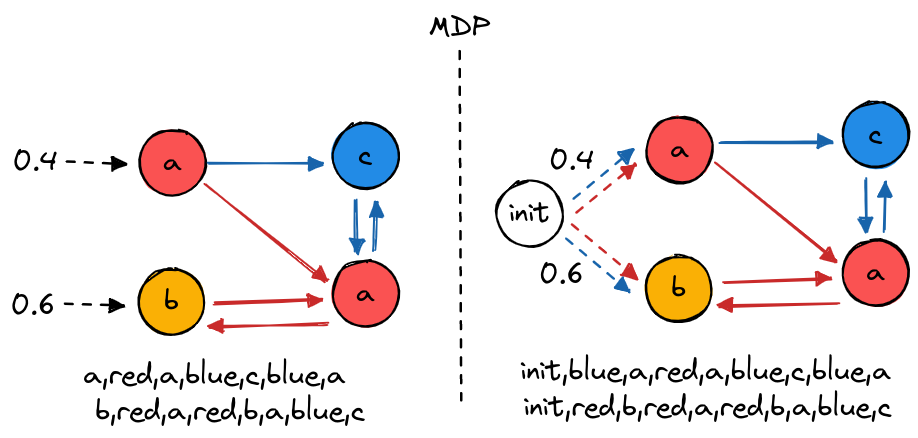
To make Jajapy models compatible with Stormpy one, Jajapy add one state labelled with init at the creation of the model. The transitions leaving this state simulate the initial distribution given by the user as on the following pictures:
The same transformation applies for MDPs, except that the transitions are available for any action.
5. Jajapy and Prism
Note
This section concerns MDPs, MCs, CTMCs and PCTMCs only. Other models are not compatible with Prism.
Jajapy can load Prism dtmc (called MC in Jajapy), ctmc and mdp. This can be useful if the SUL is described in a Prism file and one needs to generated the training set from it, or if the initial hypothesis for the Baum-Welch algorithm is described in a Prism file.
Jajapy can also save any model into a Prism file. One can use this to save the output model of the learning process.
6. Examples and tutorial
The Tutorial/Examples page contains several examples from the most basic to the most complex. It is the best place to start your journey through Jajapy!