Continuous Time Markov Chain (CTMC)
In a CTMC, each transition from \(s\) to \(s'\) is associated to a exponential probability distribution of parameter \(R(s,s')\). The probability of this transition to be triggered within \(\tau \in \mathbb{R}_{>0}\) time-units is \(1 - e^{- R(s,s') \, \tau}\). When, from a state \(s\), there are more than one outgoing transition, we are in presence of a race condition. In this case, the first transition to be triggered determines which observation is generated as well as the next state of the CTMC. According to these dynamics, the time spent in state \(s\) before any transition occurs, called waiting time (sometimes dwell time), is exponentially distributed with parameter \(E(s) = \sum_{s' \in S} R(s,s')\), called exit-rate of \(s\).
Example
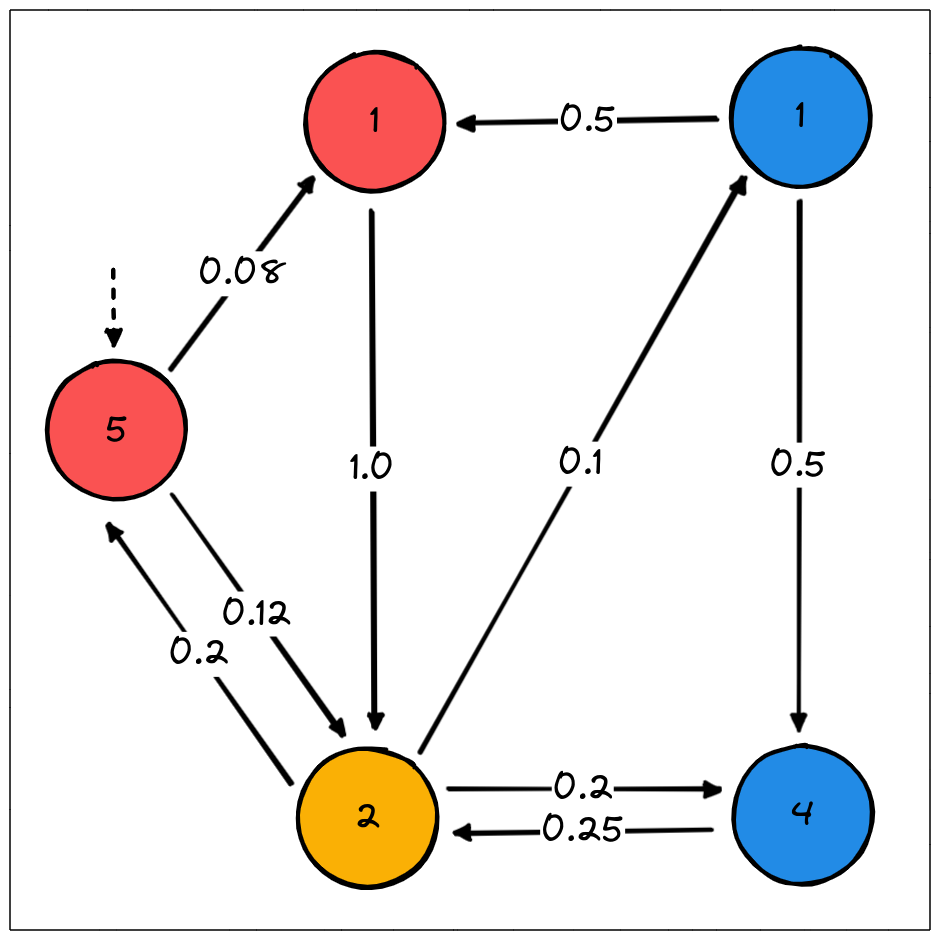
In the following picture, the values on the transitions are the parameters \(R(s,s')\). The observations, which are red, yellow, blue are represented by the color of the states. The values on each state correspond to the expected waiting time before leaving this state: it is the inverse of the exit-rate.
Creation
>>> import jajapy as ja
>>> labelling = ['red','red','yellow','blue','blue']
>>> transitions = [(0,1,0.08),(0,2,0.12),(1,1,0.3),(1,2,0.7),
                   (2,0,0.2),(2,3,0.1),(2,4,0.2),(3,3,0.8),
                   (3,1,0.1),(3,4,0.1),(4,2,0.25)]

>>> model = ja.createCTMC(transitions,labelling,initial_state=0,name="My_CTMC")
We can also generate a random CTMC
>>> random_model = CTMC_random(number_states=5,
                               alphabet=['red','yellow','blue'],
                               random_initial_state=False,
                               min_exit_rate_time = 1.0,
                               max_exit_rate_time = 5.0)
Exploration
>>> model.e(0)
0.2
>>> model.expected_time(0)
5.0
>>> model.l(0,2)
0.12
>>> model.l(0,3)
0.0
>>> model.tau(0,2,'red')
0.6
>>> model.tau(0,2,'yellow')
0.0
>>> model.lkl(0,1.0)
0.1637461506155964
>>> # which is equal to 0.2*exp(-0.2*1.0), and 0.2 == model.e(0)
>>> model.getAlphabet()
['init','red','yellow','blue']
>>> model.getLabel(2)
'yellow'
Running
>>> model.run(5) # returns a list of 5 observations plus the initial one without the waiting times
['init','red', 'yellow', 'blue', 'blue', 'yellow', 'blue']
>>> model.run(5,timed=True) # returns a list of 5 observations plus the intial one with the waiting times
['init',0.5336343726140618,'red', 1.806338759176371, 'red', 0.05237298538963968,
'red', 0.5556197125154162, 'red', 0.35592063754974723, 'red', 0.6101068433945884, 'red']
>>> s = model.generateSet(10,5,timed=True) # returns a Set containing 10 traces of size 5
>>> s.sequences
[['init', 0.10788094099666436, 'red', 1.6789349613457798, 'red', 0.27255276944298595,
'red', 0.42350152604909247, 'yellow', 0.20220224981867935, 'blue', 9.704572104709351, 'yellow'],
['init', 1.6378986557150426, 'red', 4.1800880483401555, 'yellow', 1.8656306179724005,
'red', 9.427748853607259, 'yellow', 0.21286758511326231, 'red', 2.278263556837526, 'red'],
['init', 4.514275634368433, 'red', 1.2355021955427197, 'yellow', 0.31248093363627166,
'red', 8.824559530285878, 'red', 0.4529508092055165, 'red', 0.07274692217838562, 'red'],
['init', 0.04764578868145291, 'red', 0.4723999201503642, 'yellow', 0.6743349646745602,
'red', 0.7452790320928603, 'yellow', 0.7757445460815905, 'blue', 3.1265714080061575, 'yellow'],
['init', 0.2618927236991998, 'red', 8.945809803848748, 'yellow', 1.3509604669493112,
'blue', 2.1740236675910465, 'yellow', 7.560013081702193, 'blue', 0.6371556825230754, 'yellow'],
['init', 0.555526612944214, 'red', 2.1083387658424524, 'red', 1.5993222803300493,
'yellow', 1.1866495308662353, 'blue', 0.8608021252016191, 'yellow', 1.6199990800624533, 'blue'],
['init', 0.1643966933585648, 'red', 1.3025805686943215, 'yellow', 2.6383860396412477,
'red', 18.014055444939096, 'red', 1.2034307567991924, 'yellow', 0.06152914313554882, 'red'],
['init', 1.1424402840333279, 'red', 0.7250888175057543, 'red', 0.23039664620400085,
'red', 0.8155342281890401, 'yellow', 0.06167580348263705, 'red', 3.2313274235968423, 'red'],
['init', 1.349974406242494, 'red', 4.7893235714423605, 'yellow', 2.5583220293445823,
'red', 3.1703454235936244, 'red', 0.98555132768311, 'yellow', 0.6707954977567278, 'blue'],
['init', 0.6118189872487105, 'red', 7.057133997012888, 'yellow', 0.7762876536605751,
'blue', 0.6567357090100437, 'yellow', 3.3142910438173105, 'blue', 1.397231565238264, 'blue']]
>>> s.times # each of them appears only once
[ 1, 1, 1, 1, 1, 1, 1, 1, 1, 1]
Analysis
>>> model.logLikelihood(s) # loglikelihood of this set of traces under this model
-12.185488019773823
>>> # the result is quite low since it is a timed data set.
Saving/Loading
>>> model.save("my_ctmc.txt")
>>> the_same_model = ja.loadCTMC("my_ctmc.txt")
Converting from/to Stormpy
>>> stormpy_sparse_model = model.toStormpy() # the next line is equivalent
>>> stormpy_sparse_model = ja.jajapyModeltoStormpy(model)
>>> same_model == ja.stormpyModeltoJajapy(stormpy_sparse_model)
Converting from/to Prism
>>> model.savePrism("my_ctmc.sm")
>>> same_model = ja.loadPrism("my_ctmc.sm")
Synchronous composition
Two CTMCs can be composed to create one PCTMC.
Jajapy synchronous composition follows the Prism formalism:
it allows transitions to be labelled with actions.
These actions can be used to force two or more modules to make transitions
simultaneously (i.e. to synchronise). The rate of this transition is equal to
the product of the two individual rates.
To do so, Jajapy uses the synchronous_transitions attributes of the CTMC
objects.
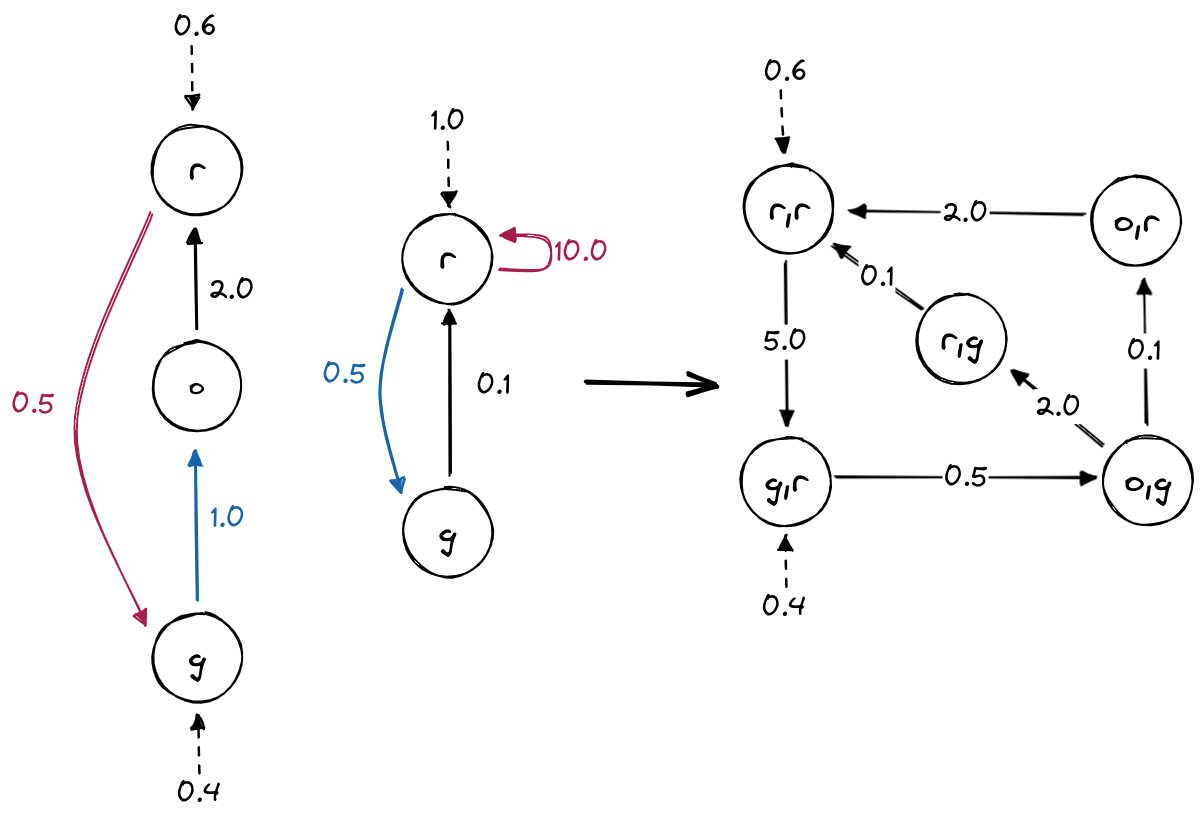
In the following example the synchronous transitions are the coloured one, the colour being the action.
>>> labelling = ['red','green','orange']
>>> transitions = [(2,0,2.0)]
>>> sync_trans = [(0,'ped_red',1,0.5), (1,'button',2,1.0)]
>>>     model1 = createCTMC(transitions,labelling,[0.6,0.4,0.0],"Car_tl",sync_trans)
>>>
>>>labelling = ['red','green']
>>> transitions = [(1,0,0.1)]
>>> sync_trans = [(0,'button',1,0.5), (0,'ped_red',0,10.0)]
>>>     model2 = createCTMC(transitions,labelling,0,"Ped_tl",sync_trans)
>>>
>>> composition = synchronousCompositionCTMCs(model1, model2)
Model
- class jajapy.CTMC(matrix: ndarray, labelling: list, name: str = 'unknown_CTMC', synchronous_transitions: list = [])
Class representing a CTMC.
Creates an CTMC.
Parameters
- matrixndarray
A (N x N) ndarray (with N the nb of states). Represents the transition matrix. matrix[s1][s2] is the rate associated to the transition from s1 to s2.
- labelling: list of str
A list of N observations (with N the nb of states). If labelling[s] == o then state of ID s is labelled by o. Each state has exactly one label.
- namestr, optional
Name of the model. Default is “unknow_CTMC”
- synchronous_transitions: list, optional.
This is useful only for synchronously composing this CTMC with another one. List of (source_state <int>, action <str>, dest_state <int>, rate <float>). Default is an empty list.
- e(s: int) float
Returns the exit rate of state
s, i.e. the sum of all the rates in this state.Returns
- sint
A state ID.
- float
An exit rate.
- expected_time(s: int) float
Returns the expected waiting time in s, i.e. the inverse of the exit rate.
Parameters
- sint
A state ID.
Returns
- float
expected waiting time in this state.
- generateSet(set_size: int, param, distribution=None, min_size=None, timed: bool = False) Set
Generates a set (training set / test set) containing
set_sizetraces.Parameters
- set_size: int
number of traces in the output set.
- param: a list, an int or a float.
the parameter(s) for the distribution. See “distribution”.
- distribution: str, optional
If
distribution=='geo'then the sequence length will be distributed by a geometric law such that the expected length ismin_size+(1/param). If distribution==None param can be an int, in this case all the seq will have the same length (param), orparamcan be a list of int. Default is None.- min_size: int, optional
see “distribution”. Default is None.
- timed: bool, optional
Only for timed model. Generate timed or non-timed traces. Default is False.
Returns
- output: Set
a set (training set / test set).
Examples
>>> set1 = model.generateSet(100,10)
>>> # set1 contains 100 traces of length 10
>>> set2 = model.generate(100, 1/4, "geo", min_size=6)
>>> # set2 contains 100 traces. The length of the traces is distributed following
>>> # a geometric distribution with parameter 1/4. All the traces contains at
>>> # least 6 observations, hence the average length of a trace is 6+(1/4)**(-1) = 10.
- getAlphabet() list
Returns the alphabet of this model.
Returns
- list of str
The alphabet of this model
Example
>>> model.getAlphabet()
['a','b','c','d','done']
- getLabel(state: int) str
Returns the label of state.
Parameters
- stateint
a state ID
Returns
- str
a label
Example
>>> model.getLabel(2)
'Label-of-state-2'
- l(s1: int, s2: int, obs: str) float
Returns the rate associated to the transition from state s1, seeing obs, to state s2.
Parameters
- s1int
A state ID.
- s2int
A state ID.
- obsstr
An observation.
Returns
- float
A rate.
- lkl(s: int, t: float) float
Returns the likelihood of staying in s state for a duration t.
Parameters
- sint
A state ID.
- tfloat
A waiting time.
Returns
- float
A Likelihood.
- logLikelihood(traces: Set) float
Computes the loglikelihood of traces under this model.
Parameters
- tracesSet
a set of traces.
Returns
- float
the loglikelihood of traces under this model.
- next(state: int) tuple
Return a state-observation pair according to the distributions described by matrix
Returns
- output(int, str)
A state-observation pair.
- pi(s: int) float
Return the probability of starting in state
s.Parameters
- s: int
state ID.
Returns
- outputfloat
the probability of starting in state s.
- run(number_steps: int, timed: bool = False) list
Simulates a run of length
number_stepsof the model and return the sequence of observations generated. Iftimedit returns a list of pairs waiting time-observation.Parameters
- number_steps: int
length of the simulation.
- timed: bool, optional
Wether or not it returns also the waiting times. Default is False.
Returns
- output: list of str
trace generated by the run.
- save(file_path: str) None
Save the model into a text file.
Parameters
- file_pathstr
path of the output file.
Examples
>>> model.save("my_model.txt")
- savePrism(file_path: str) None
Save this model into file_path in the Prism format.
Parameters
- file_pathstr
Path of the output file.
- tau(s1: int, s2: int, obs: str) float
Returns the probability to move from s1 to s2 generating observation
obs.Parameters
- s1int
A state ID.
- s2int
A state ID.
- obsstr
An observation.
Returns
- float
A probability.
- toMC(name: str = 'unknown_MC') MC
Returns the equivalent untimed MC.
Parameters
- namestr, optional
Name of the output model. By default “unknown_MC”
Returns
- MC
An equivalent untimed model.
Other Functions
- jajapy.createCTMC(transitions: list, labelling: list, initial_state, name: str = 'unknown_CTMC', synchronous_transitions: list = []) CTMC
An user-friendly way to create a CTMC.
Parameters
- transitions[ list of tuples (int, int, float)]
Each tuple represents a transition as follow: (source state ID, destination state ID, rate).
- labelling: list of str
A list of N observations (with N the nb of states). If labelling[s] == o then state of ID s is labelled by o. Each state has exactly one label.
- initial_stateint or list of float
Determine which state is the initial one (then it’s the id of the state), or what are the probability to start in each state (then it’s a list of probabilities).
- namestr, optional
Name of the model. Default is “unknow_CTMC”
- synchronous_transitions: list, optional.
This is useful only for synchronously composing this CTMC with another one. List of (source_state <int>, action <str>, dest_state <int>, rate <float>). Default is an empty list.
Returns
- CTMC
the CTMC describes by transitions, labelling, and initial_state.
Examples
>>> model = createCTMC([(0,1,1.0),(1,0,0.3),(1,1,0.2)],['b','a'],0,"My_MC")
>>> print(model)
Name: My_MC
Initial state: s0
----STATE 0--b----
Exepected waiting time: 1.0
s0 -> s1 : lambda = 1.0
----STATE 1--a----
Exepected waiting time: 2.0
s1 -> s0 : lambda = 0.3
s1 -> s1 : lambda = 0.2
- jajapy.loadCTMC(file_path: str) CTMC
Load an CTMC saved into a text file.
Parameters
- file_pathstr
Location of the text file.
Returns
- outputCTMC
The CTMC saved in file_path.
- jajapy.CTMC_random(nb_states: int, labelling: list, min_exit_rate_time: int, max_exit_rate_time: int, self_loop: bool = True, random_initial_state: bool = True, sseed: Optional[int] = None) CTMC
Generates a random CTMC. All the rates will be between 0 and 1. All the exit rates will be integers.
Parameters
- nb_statesint
Number of states.
- labellinglist of str
List of observations.
- min_exit_rate_time: int
Minimum exit rate for the states (included).
- max_exit_rate_time: int
Maximum exit rate for the states (included).
- self_loop: bool, optional
Wether or not there will be self loop in the output model. Default is True.
- random_initial_state: bool, optional
If set to True we will start in each state with a random probability, otherwise we will always start in state 0. Default is True.
- sseedint, optional
the seed value.
Returns
- CTMC
A pseudo-randomly generated CTMC.
Examples
>>> model = CTMC_random(2,['a','b'],1,5)
>>> print(model)
Name: CTMC_random_2_states
Initial state: s2
----STATE 0--a----
Exepected waiting time: 2.0
s0 -> s0 : lambda = 0.38461538461538464
s0 -> s1 : lambda = 0.11538461538461539
----STATE 1--b----
Exepected waiting time: 4.0
s1 -> s0 : lambda = 0.13636363636363635
s1 -> s1 : lambda = 0.11363636363636363
----STATE 2--init----
Exepected waiting time: 1.0
s2 -> s0 : lambda = 0.2
s2 -> s1 : lambda = 0.8
- jajapy.synchronousCompositionCTMCs(m1: CTMC, m2: CTMC, name: str = 'unknown_composition') PCTMC
Returns the synchornous compotision of m1 and m2. The output model is a PCTMC since some parameters are shared by multiple transitions.
Parameters
- m1CTMC
First CTMC to compose with.
- m2CTMC
Second CTMC to compose with.
Returns
- PCTMC
Synchronous composition of m1 and m2.