6. Parameter estimation for PCTMCs
Here, we have access to a training set and a Prism file describing a composition of two CTMCs, where the value of certain parameters is unknown. We will show how, from this training set, we can use Jajapy to estimate the parameter values.
The Tandem queueing network
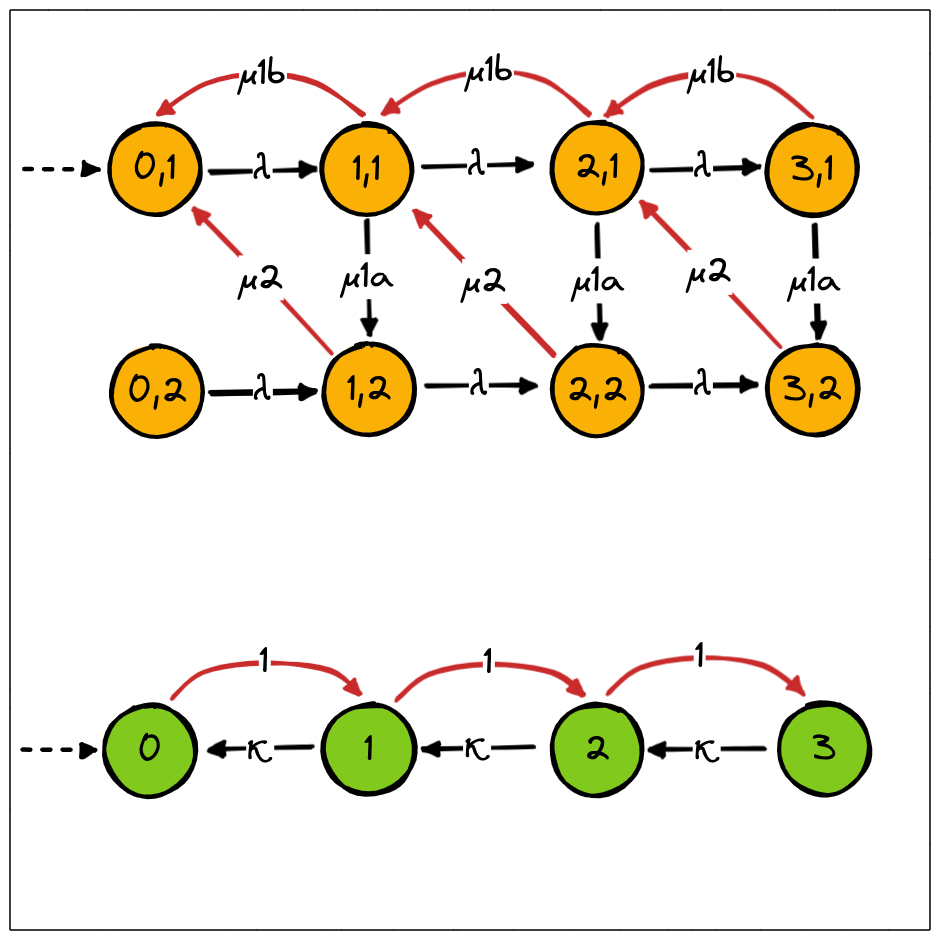
The model above represents the tandem queueing network where c=3. The yellow model corresponds to the serverC, and the green one the SeverM. For each yellow state, the first value corresponds to the value of sc and the second one to the value of phi. The red transitions are the synchronous transitions (the route transitions in the Prism file), while the black transitions are the asynchronous one.
In this example, we assume that we know the value of c and \(\lambda\), and that the serverC is fully observable (i.e. we know, at any time, in which state is the serverC). However, we don’t know the value of \(\kappa, \mu_{1a},\) \(\mu_{1b}\) and \(\mu_2\), either the current state of serverM.
We can generate the training set by loading the model, instantiating the parameters with their real values, and
using the generateSet method:
import jajapy as ja
>>> m = ja.loadPrism("tandem_3.sm")
>>> m.instantiate(["mu1a","mu1b","mu2","kappa"],[0.2,1.8,2.0,4.0])
>>> training_set = m.generateSet(100,30,timed=True)
You may notice that there is no label for the sm in the Prism file, hence, while generating the training set, there will be no information about the current state of serverM.
Parameter estimation
Now, let estimate the parameters value from the training set.
First, we need our intial hypothesis: it is the same model with the parameters left non-instantiated.
The learning method will start by instantiate the non-instantiated parameters by random values
between min_val and max_val.
>>> intial_hypothesis = loadPrism("tandem_3.sm")
>>> parameter_values = ja.BW().fit_nonInstantiatedParameters(training_set,
                                                                                                intial_hypothesis,
                                                                                                min_val=0.1, max_val=5.0)
Fitting only parameters: mu1a, mu1b, mu2, kappa
Removing unused states: from 29 states to 29
|████████████████████████████████████████| (!) 3 in 6.4s (0.47/s)

---------------------------------------------
Learning finished
Iterations:        3
Running time:      6.394461
---------------------------------------------

>>> type(parameter_values)
dict
This methods returns a dictionary with the parameter names as keys.
>>> for parameter in output_val.keys():
                print("parameter",parameter,':')
                print("Estimated value:", output_val[parameter],end='')
                print(", real value:",original_model.parameterValue(parameter))
                print()
parameter mu1a :
Estimated value: 0.202, real value: 0.2

parameter mu1b :
Estimated value: 1.86, real value: 1.8

parameter mu2 :
Estimated value: 1.938, real value: 2.0

parameter kappa :
Estimated value: 4.169, real value: 4.0