Parametric Continuous Time Markov Chain (PCTMC)
A PCTMC is a CTMC where the transition rates can be expressed as polynomial functions over a set of parameters.
Example
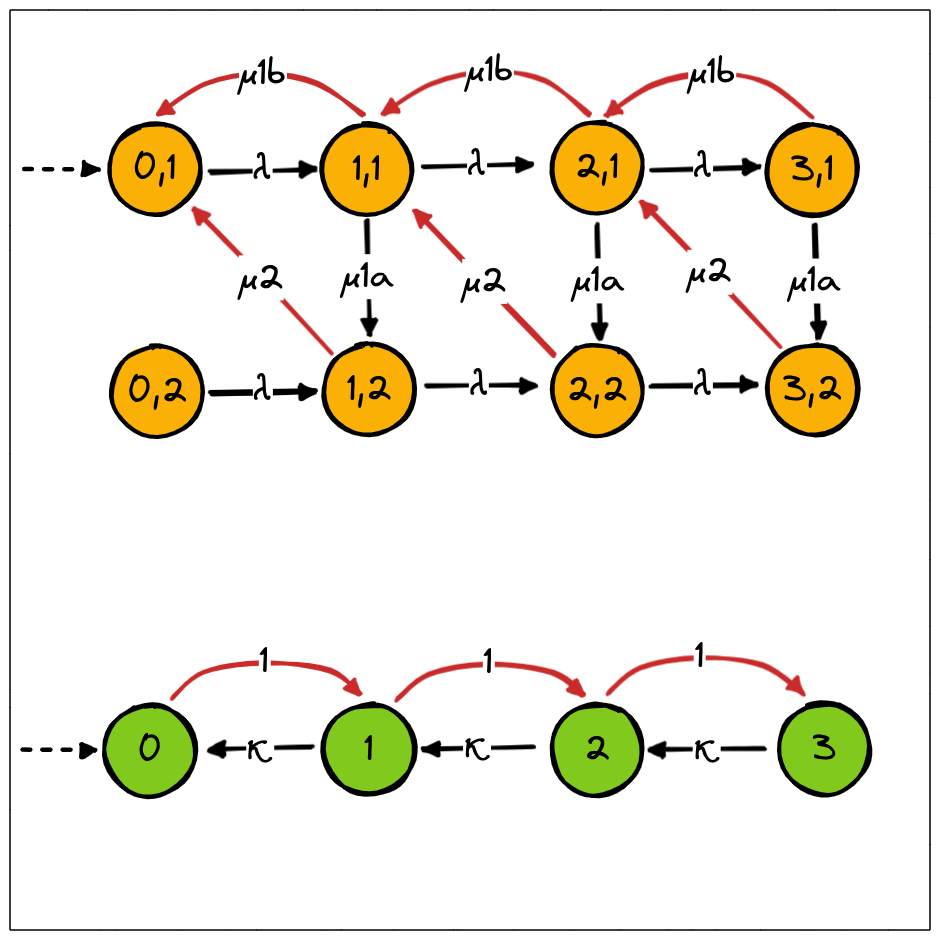
The model above represents the tandem queueing network where c=3. The yellow model corresponds to the serverC, and the green one the SeverM. For each yellow state, the first value corresponds to the value of sc and the second one the value of phi. The red transitions are the synchronous transitions (the route transitions in the Prism file), while the black transitions are the asynchronous one.
Creation
We can load the Prism file describing a PCTMC or a composition of PCMTCs as follow:
>>> import jajapy as ja
>>> model = ja.loadPrism("tandem_3.sm")
We can also create it manually using the createPCTMC function (the following will create a model for serverC only):
>>> labelling = ['sc_0_ph_1','sc_0_ph_2',
>>>             'sc_1_ph_1','sc_1_ph_2',
>>>             'sc_2_ph_1','sc_2_ph_2',
>>>             'sc_3_ph_1','sc_3_ph_2',]
>>> transitions = [(0,2,'lambda'),(2,4,'lambda'),(4,6,'lambda'),
>>>             (1,3,'lambda'),(3,5,'lambda'),(5,7,'lambda'),
>>>             (2,3,'mu1a'),(4,5,'mu1a'),(6,7,'mu1a')]
>>> sync_trans = [(2,'route',0,'mu1b'),(4,'route',2,'mu1b'),(6,'route',4,'mu1b'),
>>>             (3,'route',0,'mu2'),(5,'route',2,'mu2'),(7,'route',4,'mu2')]
>>> parameters = ['lambda','mu1a','mu1b','mu2']
>>> initial_state = 0
>>> parameter_instantiation = {'lambda':6.0}
>>> model = createPCTMC(transitions,labelling,parameters,initial_state,parameter_instantiation,sync_trans)
It is not possible to create a random PCTMC. However, we can ask Jajapy to randomly instantiate the parameters:
>>> model.isInstantiated()
False
>>> model.randomInstantiation(min_val=0.5, max_val=5.0)
>>> model.isInstantiated()
True
Converting from/to Stormpy
>>> stormpy_sparse_model = model.toStormpy() # the next line is equivalent
>>> stormpy_sparse_model = ja.jajapyModeltoStormpy(model)
>>> same_model == ja.stormpyModeltoJajapy(stormpy_sparse_model)
Converting from/to Prism
>>> model.savePrism("my_ctmc.sm")
>>> same_model = ja.loadPrism("my_ctmc.sm")
Synchronous composition
Two PCTMCs (or more) can be composed to create one PCTMC. PCTMCs composition works as CTMCs composition.
>>> composition = synchronousCompositionPCTMCs([pctmc1, pctmc2, pctmc3])
Model
- class jajapy.PCTMC(matrix: ndarray, labelling: list, transition_expr: list, parameter_values: dict, parameter_indexes: list, parameter_str: list, name: str = 'unknow_PCTMC', synchronous_transitions: list = [])
Class representing a PCTMC.
Creates an PCTMC.
Parameters
- matrixndarray
Represents the transition matrix. matrix[i,j] is the index, in transition_str, of the symbolic value of the transition from i to j.
- labelling: list of str
A list of N observations (with N the nb of states). If labelling[s] == o then state of ID s is labelled by o. Each state has exactly one label.
- transition_str: list of str
Contains the symbolic value for each transition.
- parameter_values: dict
Contains the value for each instantiated parameter. parameter_values[i] is the instantiation for parameter i. If the ith parameter is not instantiated, parameter_values[i] == nan.
- parameter_indexes: list of ndarray
Contains the indexes of each transition using each parameter. parameter_indexes[i] = array([[0,1],[2,1]]) means that parameter i is used by the transition from state 0 to state 1 and from state 2 to state 1.
- parameter_str: list
Contains the name of each parameter. parameter_str[i] is the name of parameter i. Parameter i doesn’t have a name if parameter_str[i]==None.
- namestr, optional
Name of the model. Default is “unknow_PCTMC”
- synchronous_transitions: list, optional.
This is useful only for synchronously composing this PCTMC with another one. List of (source_state <int>, action <str>, dest_state <int>, rate <float>). Default is an empty list.
- e(s: int) float
Returns the exit rate of state
s, i.e. the sum of all the rates in this state.Returns
- sint
A state ID.
- float
An exit rate.
- evaluateTransition(i: int, j: int, parameter_values: Optional[dict] = None)
Returns the value of the transition from state i to j. If parameter_values is given, the parameters are instantiated by parameter_values, otherwise by self.parameter_values. If at least one of the paramater in this transition is not instantiated, returns the symbolic representation of the transition.
Parameters
- iint
source state ID.
- jint
destination state ID.
- parameter_values: dict, optional
dictionary with the instantiation of the parameters. The keys are the parameter names (str).
Returns
- float or symbolic representation
The value of the transition from state i to j. If at least one of the paramater this transition is not instantiated, returns the symbolic representation of the transition.
- expected_time(s: int) float
Returns the expected waiting time in s, i.e. the inverse of the exit rate.
Parameters
- sint
A state ID.
Returns
- float
expected waiting time in this state.
- generateSet(set_size: int, param, distribution=None, min_size=None, timed: bool = False) Set
Generates a set (training set / test set) containing
set_sizetraces.Parameters
- set_size: int
number of traces in the output set.
- param: a list, an int or a float.
the parameter(s) for the distribution. See “distribution”.
- distribution: str, optional
If
distribution=='geo'then the sequence length will be distributed by a geometric law such that the expected length ismin_size+(1/param). If distribution==None param can be an int, in this case all the seq will have the same length (param), orparamcan be a list of int. Default is None.- min_size: int, optional
see “distribution”. Default is None.
- timed: bool, optional
Only for timed model. Generate timed or non-timed traces. Default is False.
Returns
- output: Set
a set (training set / test set).
Examples
>>> set1 = model.generateSet(100,10)
>>> # set1 contains 100 traces of length 10
>>> set2 = model.generate(100, 1/4, "geo", min_size=6)
>>> # set2 contains 100 traces. The length of the traces is distributed following
>>> # a geometric distribution with parameter 1/4. All the traces contains at
>>> # least 6 observations, hence the average length of a trace is 6+(1/4)**(-1) = 10.
- getAlphabet() list
Returns the alphabet of this model.
Returns
- list of str
The alphabet of this model
Example
>>> model.getAlphabet()
['a','b','c','d','done']
- getLabel(state: int) str
Returns the label of state.
Parameters
- stateint
a state ID
Returns
- str
a label
Example
>>> model.getLabel(2)
'Label-of-state-2'
- instantiate(parameters: list, values: list) bool
Set all the parameters in parameters to the values values.
Parameters
- parameterslist of string
List of all parameters to set. This list must contain parameter names.
- valueslist of float
List of values. parameters[i] will be set to values[i].
Returns
- bool
True if the instantiation is valid (no transition has a negative evaluation) and then applied, False if the instantiation is not valid (and then ignored).
- involvedParameters(i: int, j: int = -1) list
Returns the parameters involved in the transition from i to j. If j is not set, it returns the parameters involved in all the transitions leaving i.
Parameters
- iint
source state ID.
- jint, optional
destination state ID.
Returns
- list of str
list of parameter names.
- isInstantiated(state1: Optional[int] = None, state2: Optional[int] = None, param: Optional[str] = None) bool
If nothing is set, checks if all the parameters are instantiated. If state1 is set, checks if all the transitions leaving this state are instantiated. If state1 and state2 are set, checks if the transitions from state1 to state2 is instantiated. If param is set, checks if the parameter param is instantiated.
Parameters
- state1int, optional.
state ID.
- state2int, optional.
state ID.
- paramstr, optional
Parameter name.
Returns
- bool
True if all the requested entity(ies) is/are instantiated. See above.
- l(s1: int, s2: int, obs: str) float
Returns the rate associated to the transition from state s1, seeing obs, to state s2.
Parameters
- s1int
A state ID.
- s2int
A state ID.
- obsstr
An observation.
Returns
- float
A rate.
- lkl(s: int, t: float) float
Returns the likelihood of staying in s state for a duration t.
Parameters
- sint
A state ID.
- tfloat
A waiting time.
Returns
- float
A Likelihood.
- logLikelihood(traces: Set) float
Computes the loglikelihood of traces under this model.
Parameters
- tracesSet
a set of traces.
Returns
- float
the loglikelihood of traces under this model.
- next(state: int) tuple
Return a state-observation pair according to the distributions described by matrix
Returns
- output(int, str)
A state-observation pair.
- parameterIndexes(p: str) list
Returns the list of all transitions involving p. If the model doesn’t have any parameter p, returns an empty list.
Parameters
- pstr
parameter name.
Returns
- list
The list of all transitions involving p. If the model doesn’t have any parameter p, returns an empty list.
Examples
>>> m.parameterIndexes('x')
[[4,0],[2,3]]
>>> # the transitions from state 4 to 0 and from 2 to 3 involve 'x'.
>>> m.transitionExpression(4,0)
3*x
- parameterValue(p: str) float
Returns the value of the parameter p. If p is not instantiated, returns numpy.nan. If the model doesn’t have any parameter p, returns numpy.nan.
Parameters
- pstr
parameter name.
Returns
- float
The value of p if p is instantiated, numpy.nan otherwise. If the model doesn’t have any parameter p, returns numpy.nan.
- pi(s: int) float
Return the probability of starting in state
s.Parameters
- s: int
state ID.
Returns
- outputfloat
the probability of starting in state s.
- randomInstantiation(parameters: Optional[list] = None, min_val: Optional[float] = None, max_val: Optional[float] = None, sseed: Optional[int] = None) None
Randomly instantiated the parameters given in parameters. If parameters is not set it instantiates all the non-instantiated parameters in the model.
Parameters
- parameterslist of string, optional.
List of parameters names.
- min_valfloat, optional
Minimal value for the randomly instantiated parameters. If not set and if the model has at least two instantiated parameters, this value is equal to the parameters with the smallest instantiation. If not set and if the model has less than two instantiated parameters, this value is equal to 0.1.
- max_valfloat, optional
Maximal value for the randomly instantiated parameters. If not set and if the model has at least two instantiated parameters, this value is equal to the parameters with the highest instantiation. If not set and if the model has less than two instantiated parameters, this value is equal to 5.0.
- sseedint, optional
the seed value.
- run(number_steps: int, timed: bool = False) list
Simulates a run of length
number_stepsof the model and return the sequence of observations generated. Iftimedit returns a list of pairs waiting time-observation.Parameters
- number_steps: int
length of the simulation.
- timed: bool, optional
Wether or not it returns also the waiting times. Default is False.
Returns
- output: list of str
trace generated by the run.
- save(file_path: str) None
Save the model into a text file.
Parameters
- file_pathstr
path of the output file.
Examples
>>> model.save("my_model.txt")
- savePrism(file_path: str) None
Save this model into file_path in the Prism format.
Parameters
- file_pathstr
Path of the output file.
- tau(s1: int, s2: int, obs: str) float
Returns the probability to move from s1 to s2 generating observation
obs.Parameters
- s1int
A state ID.
- s2int
A state ID.
- obsstr
An observation.
Returns
- float
A probability.
- transitionExpression(i: int, j: int)
Returns the symbolic representation of the transition.
Parameters
- iint
source state ID.
- jint
destination state ID.
Returns
- symbolic representation
The symbolic representation of the transition.
- transitionValue(i: int, j: int)
Returns the value of the transition from state i to j. If at least one of the paramater in this transition is not instantiated, returns the symbolic representation of the transition.
Parameters
- iint
source state ID.
- jint
destination state ID.
Returns
- float or symbolic representation
The value of the transition from state i to j. If at least one of the paramater in this transition is not instantiated, returns the symbolic representation of the transition.
Other Functions
- jajapy.createPCTMC(transitions: list, labelling: list, parameters: list, initial_state, parameter_instantiation: dict = {}, synchronous_transitions=[], name: str = 'unknown_PCTMC') PCTMC
An user-friendly way to create a PCTMC.
Parameters
- transitions[ list of tuples (int, int, float or str)]
Each tuple represents a transition as follow: (source state ID, destination state ID, probability). The probability can be explicitly given (then it’s a float), or a parameter (then it’s the name of the parameter).
- labelling: list of str
A list of N observations (with N the nb of states). If labelling[s] == o then state of ID s is labelled by o. Each state has exactly one label.
- parameters: list of str.
A list containing all the parameters name.
- initial_stateint or list of float
Determine which state is the initial one (then it’s the id of the state), or what are the probability to start in each state (then it’s a list of probabilities).
- parameter_instantiation: dict
An instantion for some (or all) parameters. parameter_instantiation == {‘p’:0.5} means that parameter p should be instantiated to 0.5. The other parameters are not instantiated.
- synchronous_transitions: list, optional.
This is useful only for synchronously composing this PCTMC with another one. List of (source_state <int>, action <str>, dest_state <int>, rate <float>). Default is an empty list.
- namestr, optional
Name of the model. Default is “unknow_PCTMC”
Returns
- PCTMC
the PCTMC describes by transitions, labelling, and initial_state.
- jajapy.loadPCTMC(file_path: str) PCTMC
Load an PCTMC saved into a text file.
Parameters
- file_pathstr
Location of the text file.
Returns
- outputPCTMC
The PCTMC saved in file_path.
Examples
>>> model = loadPCTMC("my_model.txt")
- jajapy.synchronousCompositionPCTMCs(ms: list, name: str = 'unknown_composition') PCTMC
Returns the synchornous compotision of the PCTMCs in ms.
Parameters
- mslist of PCTMCs
List of PCTMCs to compose.
- namestr, optional.
Name of the output model. Default is unknown_composition.
Returns
- PCTMC
Synchronous composition of m1 and m2.